How to Start Investing With Little Money in the UK (2026 Beginner’s Guide)

Investing used to feel like something reserved for people with spare thousands sitting in a bank account. That’s no longer true. Between fractional shares, low-cost investment apps, and ISAs that shelter your gains from tax, it’s entirely possible to start investing in the UK with £20, £50, or whatever you can genuinely afford to set aside.
If you’ve been searching for how to start investing with little money in the UK, this guide walks through exactly that — not a shortcut to getting rich, but a clear understanding of what actually happens when you invest a small amount, what to expect realistically in your first year, and the mistakes that trip up most beginners before they’ve even got going.
Why Starting Small Still Works
A common myth is that small investments aren’t “worth it.” In pure pound terms, £50 growing at a typical long-term market return won’t change your life on its own. But that misses the point of starting small: you’re not investing £50, you’re building the habit of investing regularly.
Someone who invests £50 a month consistently for ten years will, in almost every historical scenario, end up better off than someone who waits five years to “save up a proper amount” before starting. Time in the market matters more than the size of your first contribution.
Understand What You’re Actually Buying
Before opening any account, get clear on the basic building blocks of what your money is actually doing once it’s invested. Skipping this step is how people end up owning something they don’t understand and panicking the first time its value moves.
- Shares — a small stake in one company. Higher risk, since your outcome depends on that one business.
- Funds and ETFs — a basket of many companies bundled together, which spreads your risk across dozens or hundreds of businesses at once.
- Bonds — essentially loans to a government or company, generally lower risk and lower potential return than shares.
- Cash-like assets within a platform — some platforms let uninvested cash sit in a money market fund or similar, which is different from your money actually being “in the market.”
For a first-time investor with a small amount, a low-cost, broadly diversified fund or ETF is usually a more sensible starting point than picking individual shares — you’re not betting everything on one company’s fortunes.

Use a Stocks and Shares ISA
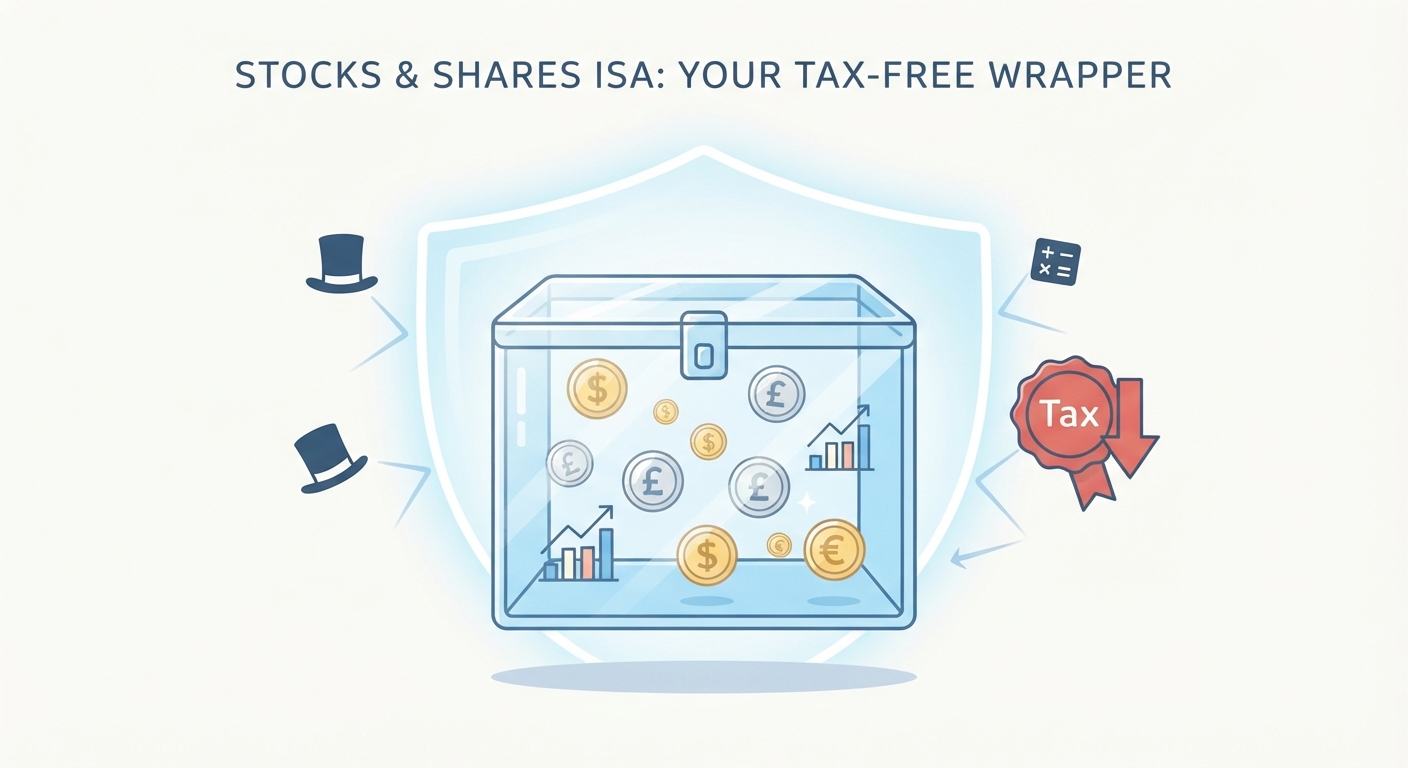
In the UK, a Stocks and Shares ISA is the standard “tax wrapper” for investing. Any growth or income inside it is free from income tax and capital gains tax. You can put up to your annual ISA allowance in per tax year, and most major platforms let you open one with a very small initial deposit. MoneyHelper’s guide to Stocks and Shares ISAs — a free, government-backed service — is a reliable place to check the current rules before opening one.
There’s no rule that says you need to fill your ISA allowance to make it worthwhile — contributing what you can afford, even £25 a month, still gets the tax benefit and starts the compounding clock. It’s also worth knowing that you can typically only pay into one Stocks and Shares ISA per tax year (though rules around this have loosened in recent years), so it’s worth picking a provider you’re happy to stick with rather than opening several at once.
How to Start Investing With Little Money in the UK: Choosing a Platform
Several UK platforms now allow you to begin with £1–£25, largely through fractional shares (owning a slice of a share rather than a whole one) and low minimum-investment funds. This has genuinely changed who can participate — you no longer need to save up £100+ just to buy a single share in an expensive company.
That said, platform choice matters more at small amounts than large ones, because fees can disproportionately eat into small balances. A flat monthly fee that’s barely noticeable on a £10,000 portfolio can quietly wipe out a meaningful chunk of a £50 one.
Before choosing a platform, check:
- Whether fees are a flat monthly charge or a percentage of your balance
- Whether there are extra charges for buying/selling
- Whether fractional shares are actually supported, or only whole shares
- Whether there’s a minimum monthly contribution requirement
- What happens to the fee structure if your balance grows — some platforms are cheap when small and expensive once you’ve built up savings, and vice versa
Comparing two or three platforms side by side against this checklist before committing is time well spent, since switching platforms later — while possible — usually involves some admin and occasionally a brief period out of the market.
Understanding Your Own Risk Tolerance
Before picking any fund, it’s worth being honest with yourself about how you’d react if your investment dropped 15% in a month. This isn’t a hypothetical — it happens periodically to markets, including in years that end up positive overall.
If a 15% dip would genuinely stress you into selling everything, that’s useful information. It might mean starting with a slightly more conservative mix (more bonds, fewer shares) even if it means a lower long-term expected return, simply because a strategy you can actually stick with beats a theoretically optimal one you abandon in a panic.
Most platforms offer some form of risk questionnaire when you sign up, and while it’s a blunt tool, it’s a reasonable starting point if you’re unsure. The honest answer to “how would I feel if this fell by a fifth” is usually more useful than the answer you’d like to give. The Financial Conduct Authority’s InvestSmart initiative offers an independent, regulator-run checklist for thinking through risk before you invest.

What a Realistic First Year Looks Like
This is the part most beginner guides skip.
Month 1–2: Your balance will barely move. This is normal. Compounding needs time, not a fast start. Many new investors check their app daily during this period looking for signs it’s “working,” and are disappointed by how uneventful it looks.
Somewhere in year one: The market will dip — sometimes by a noticeable percentage over a few weeks. This isn’t a sign you’ve done something wrong; short-term declines are a normal, expected part of investing, not an exception to it. Every major index has had multiple double-digit percentage dips within any given decade, including decades that ended with strong overall growth.
If you’re contributing monthly: A dip actually works slightly in your favour if you keep contributing, because you’re buying at a lower price during that period — a concept known as pound-cost averaging. It’s counterintuitive the first time you experience it: your portfolio value is temporarily down, and yet you’re accumulating more units of your fund per pound than you would have before the dip.
By year-end: Your result could be positive, negative, or flat. A single year is a genuinely poor window to judge whether investing is “working” — most of the value of investing shows up over five-plus years, not twelve months. Reviewing performance against a one-year window is one of the most common ways beginners talk themselves out of a strategy that would have worked fine given more time.
Knowing this in advance matters, because the single biggest mistake beginners make isn’t picking the wrong fund — it’s panic-selling after the first dip, locking in a loss that would likely have recovered given more time.
Common First-Time Mistakes to Avoid
- Checking your balance daily. It encourages emotional decisions. Weekly or monthly is plenty, and for many people, quarterly is genuinely enough.
- Chasing whatever is trending. A stock or fund becoming popular online is not the same as it being a sound investment — hype and fundamentals are different things, and by the time something is trending, a lot of its price movement may have already happened.
- Investing money you might need soon. Investments should generally be held for five years or more to ride out short-term volatility; money needed within a year or two is usually better placed in a savings account instead.
- Ignoring fees because the amounts look small. A 1% annual fee sounds trivial until you see it compounding against you over a decade — on a growing balance, that percentage represents real money every single year, not a one-off charge.
- Putting everything into one company. Even a company you believe in can underperform — spreading risk across a fund reduces the damage from any single bad outcome, and concentration risk is one of the most common ways new investors take on more risk than they realise.
Investment Platforms vs. Traditional Brokers: What’s the Difference
Newer UK investment apps have made small-amount investing far more accessible than traditional brokers, which historically expected larger minimum deposits and charged flat fees that made small investing impractical. That accessibility is genuinely valuable — but it’s worth understanding what you’re trading off.
App-based platforms tend to offer a simpler, more curated range of funds, which is helpful when you’re starting out and don’t want to be overwhelmed by thousands of options. Traditional brokers often offer a much wider range of investments, including individual international shares and more specialist funds, which becomes more relevant once your knowledge and balance both grow. Neither is objectively “better” — the right choice depends on how much guidance versus flexibility you want at this stage.
What Happens When You Want to Withdraw
One question beginners often don’t think about until later: how easy is it to get your money back out? Within a Stocks and Shares ISA, you can generally withdraw at any time — there’s no lock-in period like a pension. However, “at any time” doesn’t mean instantly; selling an investment and having the cash land back in your bank account typically takes a few working days, since the sale needs to settle first. GOV.UK’s official ISA guidance covers the current withdrawal and transfer rules in full.
It’s also worth understanding the difference between withdrawing and simply moving cash out of the market within your ISA. Some platforms let you hold cash inside your ISA without withdrawing it, which can be useful if you want to pause new contributions without fully cashing out your existing investments.
One practical implication of this: investing isn’t a good substitute for an emergency fund. If you might need instant access to cash for something unplanned, that money is better kept in an easy-access savings account, with investing reserved for money you’re setting aside for goals further down the line.
Setting Realistic Expectations for Returns
It’s tempting to look for a specific number — “what return should I expect?” — but the honest answer is that returns vary significantly year to year and can’t be reliably predicted in advance, including by professionals. What’s more useful than chasing a specific percentage is understanding the general relationship between risk and time horizon: broadly, assets with higher long-term growth potential (like company shares) also tend to experience larger short-term swings, while lower-volatility assets (like bonds or cash) tend to offer more modest long-term growth in exchange for that stability.
Be cautious of any source — including content online — that presents a specific guaranteed return figure for the stock market. Past performance of any investment, fund, or index is not a reliable indicator of what will happen in the future, and anyone presenting it as a guarantee is oversimplifying how markets actually work.
A Note on Starting During Uncertain Economic Periods
New investors sometimes delay starting because the news cycle feels uncertain — inflation concerns, interest rate changes, geopolitical events. It’s worth knowing that there has rarely, if ever, been a period in market history that felt calm and risk-free at the time. Uncertainty is a permanent feature of investing, not a temporary condition to wait out before starting.
This isn’t a reason to be reckless, but it is a reason to be sceptical of the instinct to wait for a “safer” moment to begin. For most beginners with a long time horizon, starting consistently and adjusting along the way tends to matter more than timing the first contribution perfectly.
How Much Should You Realistically Contribute?
There’s no universal “right” figure, but a useful way to think about it is to treat your investing contribution the same way you’d treat a subscription: an amount you can commit to every month without it competing with your rent, bills, or emergency savings.
A common approach is to build up an easy-access emergency fund first — often suggested as three to six months of essential expenses — before directing money toward investing. This isn’t a strict rule, but the logic behind it holds up: if an unexpected cost forces you to sell investments early, you risk having to sell at a bad time, undermining the whole point of investing for the long term.
Once that buffer exists, even a modest, sustainable monthly amount beats an ambitious one you’re likely to abandon after a few months. Consistency compounds; stop-start investing largely doesn’t.
Tax Considerations Beyond the ISA
The Stocks and Shares ISA covers most beginners’ needs, but it’s worth knowing it isn’t the only tax-efficient option in the UK. A pension, for example, also offers tax relief on contributions and is worth considering if your employer offers matching contributions — that match is effectively free money that a standalone ISA can’t replicate.
For most people just starting out, though, the ISA remains the more flexible starting point, since pensions are generally inaccessible until a much later age. The right balance between the two depends on your personal circumstances, time horizon, and whether an employer match is on the table — this is one area where, if your situation is more complex, a conversation with a regulated financial adviser can be genuinely worthwhile rather than just a formality.
Reviewing and Adjusting Your Portfolio Over Time
Once you’ve started, “leave it alone” doesn’t mean “never look at it again.” A periodic review — every six to twelve months is reasonable for a beginner portfolio — is a good habit, but the goal of that review is different from the daily balance-checking habit discussed earlier.
A useful review asks: Has my financial situation changed? Am I still comfortable with the level of risk I originally chose? Am I still contributing an amount that reflects my current circumstances? It does not need to ask: did this fund beat some other fund this month? Chasing short-term performance between reviews is one of the more common ways beginners undermine their own long-term strategy, buying into whatever performed best recently and selling whatever lagged — typically at exactly the wrong moments.
As your balance grows and your confidence builds, it’s natural for your strategy to evolve too — perhaps exploring a wider range of funds, or gradually increasing your contribution as your income allows. That evolution should happen deliberately, during a scheduled review, rather than reactively in response to a single good or bad week in the market.
How to Start Investing With Little Money: A Simple Step-by-Step Way to Begin
- Decide an amount you can invest regularly without it affecting your day-to-day finances — even £20–£50 a month is a legitimate starting point.
- Open a Stocks and Shares ISA with a provider that supports fractional shares and has fee structures suited to small balances.
- Choose a broadly diversified, low-cost fund or ETF rather than individual shares, at least initially.
- Set up an automatic monthly contribution so you’re not relying on remembering to do it manually.
- Leave it alone. Review it every few months, not every few days.
Setting up the automatic contribution in step four is arguably the single most impactful decision in this whole guide. Automating it removes the decision-making from each individual month, and consistency — not timing the market cleverly — is what actually drives results for most beginner investors over time.
A Short Glossary for Beginners
- Fractional share — owning a portion of a single share rather than a whole one, allowing small amounts to buy into expensive stocks.
- Diversification — spreading investments across many assets to reduce the impact of any single one performing badly.
- Pound-cost averaging — investing a fixed amount at regular intervals, which averages out the price you pay over time.
- Compounding — earning returns not just on your original investment, but on the returns it has already generated.
- Volatility — how much an investment’s value moves up and down over a given period.
Frequently Asked Questions
Is it worth investing small amounts? Yes — the value comes from consistency and time in the market, not the size of any single contribution.
How much do I need to open a Stocks and Shares ISA? Many UK platforms now allow you to open one and start investing with as little as £1–£25, though this varies by provider.
Can I lose money investing a small amount? Yes. Investment value can fall as well as rise, regardless of how much you invest. Only invest money you can afford to have go down in value, especially in the short term.
Should I pick individual shares or a fund when starting out? For most beginners, a diversified low-cost fund or ETF is a more sensible starting point than individual shares, since it spreads risk across many companies rather than depending on one.
What’s the biggest mistake new investors make? Selling in a panic after the first market dip, rather than staying invested through short-term volatility.
How often should I check my investments? Monthly or quarterly is generally plenty for a long-term beginner portfolio. Daily checking tends to increase anxiety without adding useful information.
Do I need to know how to pick stocks to get started? No. A diversified fund removes the need to select individual companies, which is exactly why it’s a common starting point for beginners.
For More Visits: NewsPresso
Also Read: Kerala Lottery Guessing Number Ultimate Smart Guide 2025