
Introduction
Education has changed dramatically over the last few years, and artificial intelligence has become one of the biggest reasons behind this transformation. Students are no longer limited to traditional textbooks, handwritten notes, or lengthy research sessions. Today, AI tools help learners understand difficult concepts, organize study materials, improve writing, create presentations, solve mathematical problems, learn programming, practice languages, and prepare for exams more efficiently than ever before.
The growing popularity of AI in education is not about replacing learning; it is about improving it. When used responsibly, AI acts like a personal study assistant that is available whenever students need support. Whether someone is in high school, college, or university, AI can reduce repetitive work and create more time for understanding ideas instead of struggling with routine tasks.
Modern students face many challenges. They often balance multiple subjects, assignments, projects, presentations, internships, and extracurricular activities. Managing all these responsibilities can become overwhelming. AI tools simplify many of these tasks by offering intelligent suggestions, personalized explanations, and faster ways to complete academic work without sacrificing quality.
However, simply having access to AI tools is not enough. Students also need to understand which tools are actually useful, how they should be used ethically, and where AI should support learning instead of replacing critical thinking. Choosing the right platform depends on academic goals, study habits, and the type of work being completed.
This guide explores the best AI tools for students, explains how each category improves learning, and shares practical strategies for using artificial intelligence effectively throughout academic life.
Why AI Is Becoming Essential for Students
Technology has always influenced education, but artificial intelligence has introduced something entirely different. Instead of simply providing information, AI interacts with students, answers questions, explains concepts in multiple ways, identifies mistakes, and adapts responses based on individual learning needs.
Imagine studying a difficult biology chapter late at night. Instead of waiting until the next classroom session, a student can ask an AI assistant for explanations, examples, quizzes, and summaries. The learning process becomes continuous rather than limited to classroom hours.
Similarly, students writing research papers can receive guidance on improving grammar, organizing paragraphs, strengthening arguments, and maintaining clarity. AI can point out areas that need improvement while encouraging students to think critically about their work.
Programming students benefit by receiving coding explanations, debugging assistance, and algorithm walkthroughs. Mathematics students can understand complex equations step by step rather than simply receiving final answers. Language learners gain access to conversation practice, vocabulary exercises, pronunciation tips, and grammar corrections.
These advantages explain why AI has quickly become an important educational companion rather than just another piece of software.
Benefits of Using AI Tools for Students
One of the greatest advantages of AI is the amount of time it saves. Many academic tasks require repetitive work that consumes valuable study hours. AI automates portions of these tasks, allowing students to focus on deeper learning.
Another significant benefit is personalized learning. Every student learns differently. Some understand through examples, while others prefer detailed explanations or visual demonstrations. AI can present information in different formats depending on what helps the learner most.
AI also improves productivity by organizing schedules, tracking assignments, summarizing long documents, generating practice questions, and creating study plans. Instead of spending hours searching through multiple websites, students can quickly gather organized information.
Confidence is another important advantage. Students often hesitate to ask teachers repeated questions. AI allows unlimited practice without fear of judgment, making learning more comfortable and encouraging curiosity.
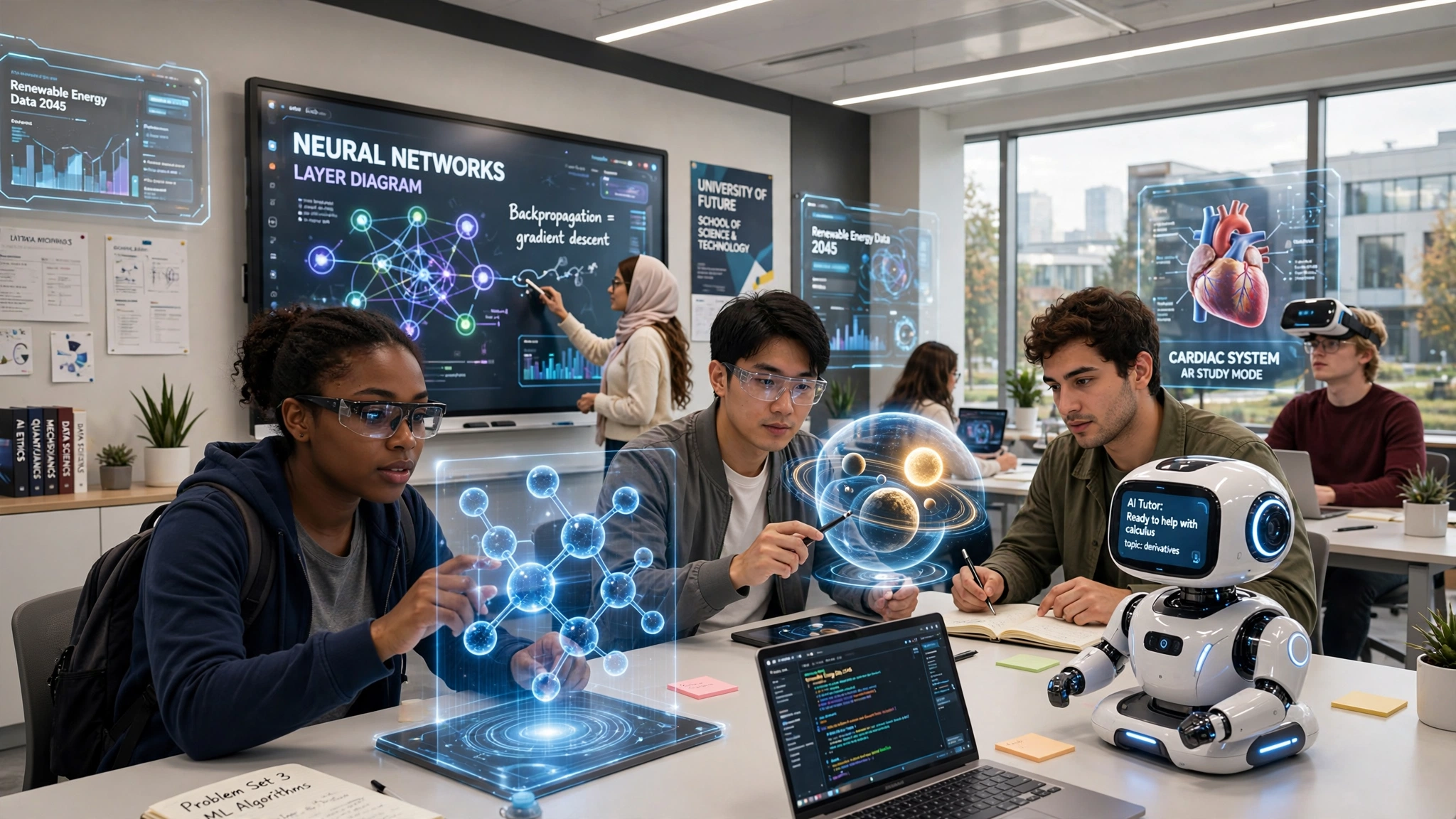
Categories of AI Tools Every Student Should Know
Rather than thinking about individual applications, it is more useful to understand AI tools by category. Different categories solve different academic problems.
Writing assistants help students improve grammar, sentence structure, vocabulary, and clarity.
Research assistants simplify information gathering by organizing complex topics into understandable summaries.
Study assistants generate quizzes, flashcards, revision notes, and personalized explanations.
Coding assistants help computer science students understand programming languages and debug software.
Presentation generators assist in creating professional slides with organized layouts and visual improvements.
Mathematics assistants explain calculations step by step instead of merely displaying answers.
Language learning assistants support vocabulary building, pronunciation, translation, and conversational practice.
Productivity assistants organize calendars, assignments, reminders, and academic planning.
Understanding these categories helps students choose the right solution for each academic challenge instead of relying on a single AI application.
AI Writing Assistants
Writing is one of the most important academic skills. Essays, reports, research papers, scholarship applications, presentations, and emails all require strong communication.
AI writing assistants help students identify grammatical mistakes, improve sentence flow, eliminate repetition, strengthen vocabulary, and maintain professional writing standards.
However, these tools should never replace original thinking. Instead, they should function like experienced editors who suggest improvements after students write their own ideas.
Students who regularly revise their work using AI often develop stronger writing habits because they begin recognizing common mistakes independently.
Another useful feature is readability improvement. Academic writing sometimes becomes overly complicated. AI helps simplify complex sentences while preserving meaning, making assignments easier for professors and classmates to understand.
AI Research Assistants
Research often consumes more time than writing itself. Students may spend hours locating reliable information, organizing notes, comparing ideas, and identifying relevant concepts.
AI research assistants simplify this process by organizing information logically, explaining unfamiliar terminology, and helping students understand relationships between different concepts.
Instead of reading dozens of unrelated sources before understanding a topic, students can use AI to obtain structured overviews before conducting deeper independent research.
This approach saves time while improving comprehension.
It remains important, however, for students to verify important facts, consult official academic sources, and avoid relying entirely on AI-generated information when writing research papers.
Responsible use produces stronger academic outcomes than blind dependence.

AI Study Assistants
Many students spend hours rereading textbooks without actually remembering important information.
AI study assistants change this by transforming passive reading into active learning.
Students can upload notes and request summaries that highlight the most important ideas. AI can generate quizzes, multiple-choice questions, flashcards, fill-in-the-blank exercises, and short-answer tests based on uploaded material.
Repeated testing improves long-term memory far more effectively than simple rereading.
Some AI study assistants even adjust question difficulty depending on student performance, creating personalized revision sessions that become more challenging as understanding improves.
This adaptive learning approach helps students identify weak areas before examinations.
AI Tools for Mathematics
Mathematics is one of the subjects where students most frequently become frustrated.
Many learners receive the correct answer but still do not understand how the solution was reached.
Modern AI mathematics assistants solve this problem by providing detailed step-by-step explanations.
Instead of jumping directly to the final answer, they explain formulas, substitutions, calculations, and reasoning behind each step.
Students studying algebra, geometry, calculus, statistics, probability, or linear algebra benefit significantly from these guided explanations.
Over time, understanding the process becomes more valuable than memorizing formulas because students gain confidence solving unfamiliar problems independently.
AI Coding Assistants
Programming students often spend hours searching for small syntax errors or debugging complicated software problems.
AI coding assistants dramatically reduce this frustration.
These systems explain programming concepts, identify bugs, suggest improvements, optimize algorithms, and even teach new programming languages through interactive examples.
Instead of copying code, students should use these assistants to understand why certain solutions work.
Learning programming requires logical thinking, problem solving, and experimentation. AI supports these skills when used responsibly.
Students studying Python, JavaScript, Java, C++, C#, SQL, and web development often benefit from intelligent code explanations that simplify difficult concepts.
AI Presentation Makers
Creating presentations is another time-consuming academic responsibility.
Students often struggle with slide design even after completing their research.
AI presentation tools automatically organize information into professional layouts while suggesting appropriate headings, visual hierarchy, icons, graphics, and concise summaries.
Instead of spending hours adjusting fonts, colors, and spacing, students can focus on explaining ideas effectively.
Presentation quality improves because AI assists with structure while students provide the actual content and knowledge.
This combination leads to presentations that are visually appealing without sacrificing educational value.

Responsible Use of AI in Education
Although AI offers enormous benefits, students must use it ethically.
Assignments should always reflect original understanding rather than copied AI responses.
Artificial intelligence should support brainstorming, editing, explanation, organization, and practice—not replace genuine learning.
Students who depend entirely on AI may complete assignments quickly but struggle during examinations where independent thinking becomes essential.
Responsible use creates better long-term academic success because students continue developing research, writing, analysis, creativity, and critical thinking skills alongside technological assistance.
Teachers increasingly encourage students to use AI responsibly while expecting transparency and academic integrity.
Exploring the Best AI Tools for Students
Artificial intelligence has introduced hundreds of educational platforms, but not every tool delivers the same value. Some specialize in writing, while others are designed for mathematics, programming, research, language learning, or productivity. Choosing the right tool depends on your academic needs rather than simply downloading the most popular application.
The most successful students usually combine several AI tools instead of relying on a single platform. For example, one application may help with brainstorming ideas, another may organize lecture notes, while a third improves grammar or creates presentations. Together, these tools form a complete digital study environment that saves time without replacing genuine learning.
The following categories explain how different AI-powered solutions can improve every stage of a student’s academic journey.
AI Chat Assistants for Everyday Learning
General AI assistants have become one of the most useful resources for students because they can answer questions across almost every subject. Whether someone is studying history, biology, economics, computer science, psychology, or engineering, these assistants provide explanations in simple language that are easier to understand than many textbooks.
Instead of reading an entire chapter repeatedly, students can ask for a summary, request real-life examples, or have difficult topics explained step by step. If one explanation is confusing, they can immediately ask for another version until the concept becomes clear.
Another advantage is interactive learning. Students can hold conversations instead of reading static material. Asking follow-up questions encourages deeper understanding and often reveals connections between different topics that might otherwise be missed.
These assistants are especially useful before examinations because they can create practice questions, explain incorrect answers, and simulate classroom discussions.
AI Note-Taking Tools
Many students struggle to organize information collected during lectures. Handwritten notes may become messy, while digital documents often contain incomplete ideas that are difficult to review later.
AI-powered note-taking applications solve this problem by organizing information automatically. They can summarize lengthy notes, identify important concepts, create headings, and separate supporting details from main ideas.
Some students also use AI after class by copying lecture notes into an assistant and asking for simplified explanations. Others request memory tricks, examples, or short quizzes based on the same material.
This process transforms ordinary notes into active learning resources instead of simple records of classroom discussions.
AI Tools for Research
Research assignments require students to understand unfamiliar topics quickly before developing their own analysis. AI significantly speeds up the early stages of this process.
Students can ask AI to explain technical terms, compare theories, define important concepts, or provide structured overviews before beginning independent research.
Instead of becoming overwhelmed by hundreds of pages of information, learners first develop a clear understanding of the subject. This foundation makes later reading more productive because students already understand the basic ideas.
AI also helps organize research questions, identify possible essay structures, and suggest logical connections between related concepts. However, academic work should always be supported by reliable references and careful verification.

AI Writing and Editing Tools
Strong writing is valuable in every academic discipline. Whether preparing essays, laboratory reports, dissertations, scholarship applications, or internship emails, students benefit from clear communication.
AI editing tools help improve grammar, punctuation, sentence variety, vocabulary, and readability. They also identify repetitive language, awkward phrasing, and unclear arguments.
Instead of rewriting entire assignments, students should first complete their own drafts. AI then acts as a professional editor by suggesting improvements while preserving the student’s original voice.
Repeated editing sessions also help students become better writers because they gradually recognize common mistakes before submitting future assignments.
AI Presentation Tools
Presentations are often graded on both content and delivery. Even excellent research may receive lower marks if slides appear crowded, disorganized, or difficult to understand.
AI presentation assistants simplify the design process by arranging information into professional layouts, suggesting visual improvements, and creating attractive slide structures.
Students can focus on understanding their topic while AI handles formatting, spacing, and organization.
Good presentations also require storytelling. AI can help students organize ideas logically, ensuring that each slide naturally leads to the next instead of appearing disconnected.
The final presentation remains original because students provide the knowledge while AI assists with communication.
AI Tools for Mathematics
Mathematics becomes much easier when students understand the reasoning behind each calculation.
Modern AI mathematics assistants explain every stage of a solution instead of only displaying answers.
For example, instead of solving an algebra problem immediately, AI may explain why a particular formula applies, demonstrate each substitution, simplify calculations gradually, and verify the final result.
This learning style builds confidence because students begin recognizing problem-solving patterns rather than memorizing isolated formulas.
Subjects such as algebra, geometry, calculus, statistics, probability, and trigonometry become easier to master when students focus on understanding processes instead of simply obtaining correct answers.
AI for Programming Students
Programming is fundamentally about solving problems through logical thinking.
AI coding assistants help students understand programming concepts by explaining syntax, identifying bugs, improving code readability, and suggesting better solutions.
When beginners encounter compiler errors, AI can explain why the error occurred instead of simply correcting it.
Students studying web development benefit from guidance in HTML, CSS, JavaScript, TypeScript, Python, Java, SQL, and many other languages.
More importantly, AI encourages experimentation. Students can compare different programming approaches, understand algorithm efficiency, and gradually improve coding habits through continuous feedback.
AI Language Learning Assistants
Learning a new language requires regular practice, which many students struggle to maintain.
AI language assistants provide opportunities to practice grammar, vocabulary, pronunciation, listening, reading, and conversation without requiring a human tutor.
Students can translate difficult passages, practice speaking exercises, generate vocabulary quizzes, and receive pronunciation corrections instantly.
Interactive conversations also improve confidence because learners can practice repeatedly without worrying about making mistakes in front of classmates.
Daily interaction with AI creates consistent language exposure, one of the most important factors in successful language acquisition.
AI Productivity Tools
Academic success depends not only on intelligence but also on organization.
Students frequently manage multiple assignments, examination schedules, presentations, laboratory work, internships, and extracurricular activities simultaneously.
AI productivity assistants simplify planning by organizing calendars, reminding students about deadlines, prioritizing important tasks, and creating study schedules.
Instead of feeling overwhelmed by large workloads, students can divide projects into smaller daily goals.
This structured approach reduces stress while improving consistency throughout the semester.
Choosing the Right AI Tool
Not every student requires every AI application.
Someone studying computer science may benefit most from coding assistants, while a literature student might prioritize writing and research tools.
Medical students often prefer AI platforms capable of explaining complex biological concepts, whereas engineering students frequently use mathematics and programming assistants.
Before selecting any AI tool, students should consider the subjects they study most often, the tasks consuming the most time, and the skills they want to improve.
Choosing fewer high-quality tools usually produces better results than installing dozens of applications that are rarely used.
Common Mistakes Students Make When Using AI
Despite its advantages, AI can become harmful when used carelessly.
One common mistake is copying AI-generated content directly into assignments without understanding it. This prevents genuine learning and often results in weak classroom performance during discussions or examinations.
Another mistake is assuming AI is always correct. Although modern systems are remarkably capable, they occasionally produce inaccurate explanations or misunderstand questions.
Students should develop the habit of verifying important information, especially when preparing research papers or technical assignments.
Some learners also become overly dependent on AI for simple tasks that they could complete independently. Over time, this weakens problem-solving abilities.
The healthiest approach is to let AI support learning rather than replace thinking.
Building Better Study Habits with AI
Artificial intelligence works best when combined with disciplined study habits.
Students should begin by attending lectures, reading textbooks, and attempting assignments independently. AI can then be used to review difficult concepts, identify mistakes, generate additional practice questions, and strengthen understanding.
Reviewing material regularly is more effective than last-minute cramming. AI makes this easier by creating personalized revision schedules and short daily quizzes.
Students should also ask “why” questions instead of only requesting answers. Understanding reasoning creates deeper knowledge that remains useful long after examinations have ended.
Advanced Strategies for Using AI Throughout the Academic Year
Many students begin using artificial intelligence only when assignments are due or exams are approaching. While AI is certainly helpful during these stressful periods, its real value comes from consistent use throughout the academic year. Students who build AI into their daily study routine often experience steady improvement in understanding, organization, and confidence.
One effective strategy is to use AI before attending lectures. Reading a short overview of the upcoming topic helps students recognize important concepts during class. Instead of hearing unfamiliar terminology for the first time, they already have a basic understanding that allows them to follow the instructor more easily.
After each lecture, AI can reinforce learning by summarizing notes, explaining confusing sections, and generating a few practice questions. This immediate review strengthens memory and reduces the amount of revision required before examinations.
Weekly revision is another area where AI excels. Instead of rereading hundreds of pages, students can review concise summaries, answer self-generated quizzes, and revisit topics they answered incorrectly. This gradual approach reduces stress and makes learning more manageable throughout the semester.
Using AI for Exam Preparation
Examinations often create pressure because students try to review an entire semester’s worth of material in a short period. AI helps organize this process by identifying priorities and creating structured study plans.
Students can begin by asking AI to divide large subjects into smaller sections. Breaking a challenging course into manageable daily goals makes revision less overwhelming and easier to track.
Practice testing is another major advantage. Instead of simply reviewing notes, students can ask AI to generate multiple-choice questions, short-answer exercises, case studies, or essay prompts. Actively recalling information improves long-term retention far more effectively than passive reading.
Students should also request explanations for incorrect answers. Understanding why a mistake occurred often provides greater educational value than simply memorizing the correct response.
Mock examinations created by AI can also simulate real testing conditions, helping students improve both speed and confidence before the actual exam.
AI and Group Projects
Collaboration is an important part of modern education, and AI can make group projects more organized without replacing teamwork.
Students can use AI to create meeting agendas, divide responsibilities, summarize discussions, and combine ideas into a logical project structure. This helps ensure that every team member understands the project’s direction.
During report writing, AI can improve consistency between sections written by different students. It can suggest smoother transitions, identify repeated information, and improve readability while preserving each contributor’s original ideas.
For presentations, AI can recommend logical slide sequences, concise speaker notes, and visually balanced layouts. The technology supports collaboration without taking ownership of the creative work.
Developing Critical Thinking Alongside AI
One concern about artificial intelligence is that students may become passive learners who accept every answer without questioning it. The solution is to use AI as a conversation partner rather than an unquestioned authority.
Students should regularly ask follow-up questions such as:
- Why does this solution work?
- Is there another way to solve this problem?
- What assumptions are being made?
- Can you explain this with a real-world example?
- What are the limitations of this approach?
These questions encourage deeper understanding and strengthen analytical thinking.
Critical thinking remains one of the most valuable academic skills because it enables students to evaluate information independently rather than relying solely on technology.

Academic Integrity and Responsible AI Use
As AI becomes more common in education, maintaining academic integrity becomes increasingly important.
Students should never submit AI-generated work as entirely their own without meaningful contribution. Assignments are designed to measure understanding, creativity, analysis, and communication. If AI replaces all of these elements, the educational purpose is lost.
A responsible approach involves using AI to brainstorm ideas, clarify concepts, improve grammar, organize content, or create practice questions. The student’s own reasoning, research, and conclusions should remain at the center of every assignment.
Educational institutions are continuing to develop policies regarding AI usage, making honesty and transparency more important than ever.
The Future of AI in Education
Artificial intelligence will continue transforming education over the coming years. Future learning platforms are likely to become even more personalized, adapting to each student’s strengths, weaknesses, pace, and preferred learning style.
Virtual tutors may provide individualized lessons that adjust in real time based on student performance. Interactive simulations could allow learners to practice scientific experiments, engineering designs, medical procedures, or historical scenarios in immersive digital environments.
AI may also assist teachers by identifying students who need additional support, reducing administrative workloads, and creating customized learning materials.
Despite these advances, human teachers will remain essential. Education is about more than information—it includes mentorship, encouragement, creativity, collaboration, and ethical development. AI is best viewed as a powerful educational tool that complements, rather than replaces, the role of educators.
Tips for Getting the Most Value from AI
Students who achieve the best results with AI usually follow a few simple habits.
Start by asking clear and specific questions. Detailed prompts often produce more useful answers than vague requests.
Always review AI-generated responses carefully instead of accepting them immediately. Look for opportunities to expand, verify, and improve the information using your own understanding.
Use AI consistently rather than only during emergencies. Short daily interactions build stronger knowledge than occasional intensive sessions.
Finally, remember that learning happens through effort. AI should make studying more efficient, not eliminate the thinking process that leads to genuine understanding.
Frequently Asked Questions
What are AI tools for students?
AI tools for students are intelligent software applications that assist with learning, writing, research, coding, mathematics, note-taking, language learning, presentations, and productivity. They help students study more efficiently while supporting skill development.
Are AI tools suitable for every subject?
Most subjects can benefit from AI support. Science, mathematics, engineering, business, medicine, computer science, literature, history, and language studies all have AI applications that simplify learning and improve productivity.
Can AI improve academic writing?
Yes. AI can identify grammar mistakes, improve sentence structure, enhance clarity, and suggest stronger organization. Students should still write their own ideas and use AI primarily for revision and improvement.
Is it acceptable to use AI for homework?
That depends on your school’s or university’s policies. In many cases, using AI to understand concepts, organize ideas, or improve writing is acceptable, while submitting AI-generated work as your own may violate academic integrity rules. Always follow your institution’s guidelines.
Can AI replace teachers?
No. AI provides explanations, practice, and organizational support, but teachers offer mentorship, feedback, classroom discussion, and personal guidance that technology cannot fully replace.
Are free AI tools enough for students?
Many free AI tools provide valuable features that meet the needs of most students. Premium versions may offer additional capabilities, but effective learning depends more on how the tools are used than on the subscription level.
How can students avoid becoming too dependent on AI?
Students should first attempt problems independently, use AI to check or improve their work, verify important information, and continue practicing critical thinking and problem-solving without relying on AI for every task.
Which students benefit the most from AI?
High school students, college learners, university researchers, language learners, programming students, and lifelong learners can all benefit. AI adapts to different educational levels and learning goals.
Conclusion
Artificial intelligence has become one of the most significant developments in modern education. It empowers students to learn more effectively, organize their work, strengthen academic skills, and approach complex subjects with greater confidence. From writing essays and solving mathematical problems to preparing presentations and learning new programming languages, AI offers practical support across nearly every area of study.
However, technology is most valuable when combined with curiosity, discipline, and independent thinking. Students who use AI responsibly develop stronger understanding rather than simply completing assignments more quickly. They ask better questions, practice consistently, review mistakes carefully, and continue building the critical thinking skills that remain essential in both education and future careers.
As AI continues to evolve, students who learn to work alongside these tools—rather than relying on them completely—will be better prepared for academic success and the rapidly changing professional world. The future of education is not about choosing between human intelligence and artificial intelligence; it is about combining both to create a richer, more effective, and more engaging learning experience.
For More Visits: NewsPresso
Also Read: AWT88K Meaning – Smart Explanation Revealed 2025